
Football Guides
Football Formations Explained
A football formation describes how a team's ten outfield players are arranged, counted from defence to attack. A 4-3-3 has four defenders, three midfielders and three forwards; the goalkeeper is not included in the numbers.
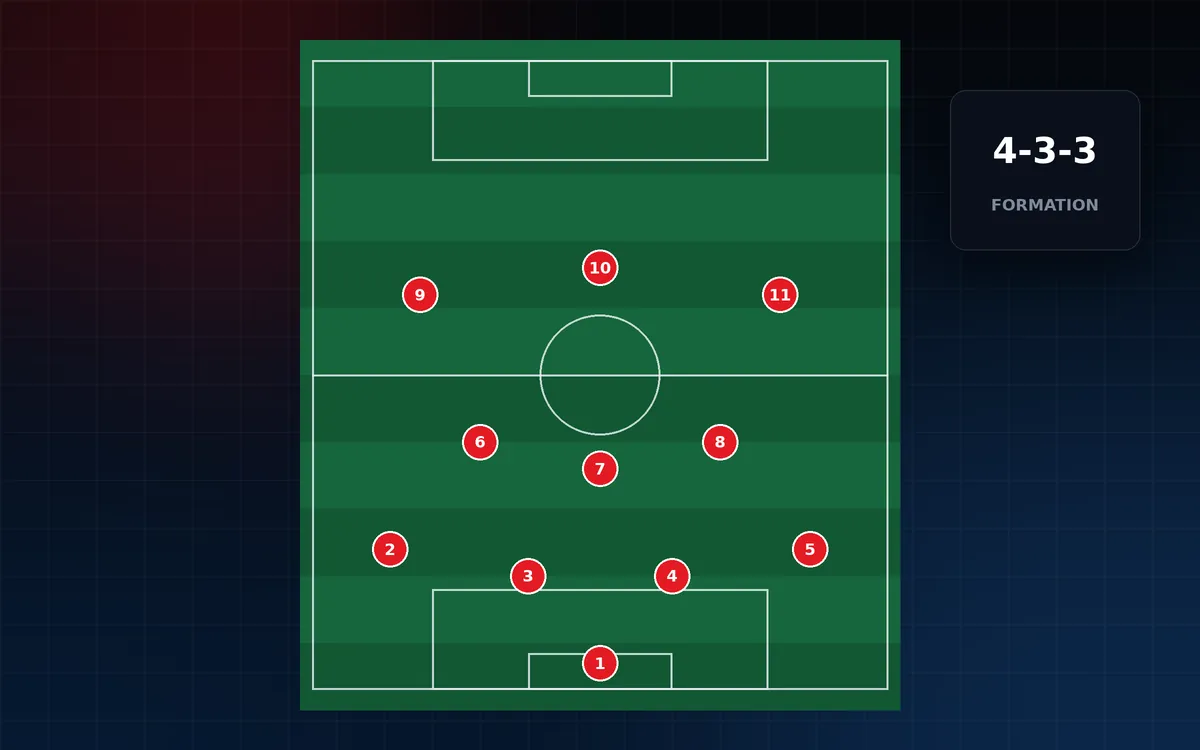
How formation numbers work
Formation numbers list outfield players by line, from the back. They always add up to ten. A 4-2-3-1 has four defenders, two defensive midfielders, three attacking midfielders and one striker. Extra digits simply describe more lines.
Common formations
| Formation | Shape | Typical strengths | Typical trade-offs |
|---|---|---|---|
| 4-4-2 | Two banks of four and two strikers | Compact, simple, two forwards to support each other | Can be outnumbered in central midfield |
| 4-3-3 | Three central midfielders and a front three | Width in attack, strong pressing shape | Full-backs must cover a lot of ground |
| 4-2-3-1 | Two holding midfielders behind three attacking midfielders | Balanced; protects the back four | A lone striker can be isolated |
| 3-5-2 | Three centre-backs, wing-backs and two strikers | Numbers in midfield and a strike partnership | Wide areas depend on wing-backs' stamina |
| 3-4-3 | Three centre-backs, four midfielders and a front three | Attacking width and pressing | Can leave space behind wing-backs |
| 5-3-2 / 5-4-1 | Five defenders when wing-backs drop deep | Defensive solidity | Fewer players to attack with |
In and out of possession
Teams rarely hold one shape for 90 minutes. A side listed as 4-3-3 may build attacks as a 3-2-5 when a full-back steps into midfield, then defend as a 4-5-1. That is why modern analysis describes shapes by phase: in possession, out of possession and in transition. Read about pressing and possession
Roles within a formation
- Full-backs and wing-backs: defend the flanks; wing-backs play higher and provide most of the width in back-three systems.
- Holding midfielder: protects the defence and starts attacks.
- Number 10: an attacking midfielder who plays between the opponent's midfield and defence.
- Target striker vs. false nine: one holds the ball up in the box; the other drops deep to create space for others.
What formations do not tell you
A formation is a starting point, not a full description. Player roles, pressing height and how a team moves together matter more than the numbers on a team sheet. Use formations alongside match statistics and match analysis.